Contact
What Is Chronic Venous Insufficiency?
Chronic Venous Insufficiency (CVI) is form of Venous Disease that occurs when the veins in your legs are damaged. As a result, these veins can't manage blood flow as well as they shouldd, and it's harder for blood in your legs to return to your heart. CVI causes blood to pool in your leg veins, leading to high pressure in those veins¹.
CVI is not just cosmetic. Over time, it can cause pain, swelling, leg heaviness, and skin changes. Advanced cases may lead to ulcerations and significant mobility challenges.
CVI is degenerative, meaning it becomes more severe if untreated. Early diagnosis and intervention are key to preventing long-term complications and maintaining quality of life.
Risks of Chronic Venous Insufficiency
The most common masifestation of CVI is varicose veins while other signs include reticular veins and telangiectasias².
Telangiectasias are dilated venules or arterioles (small superficial veins) measuring less than 1 mm. Reticular veins have a small diameter (less than 3 mm) and are tortuous veins located in the subcutaneous tissue. Patients with telangiectasias and reticular veins can experience itching, burning or pain.³
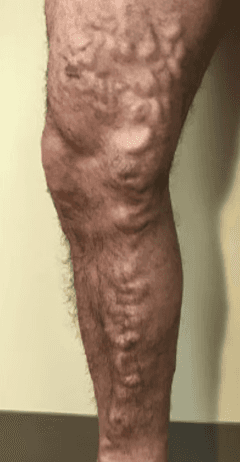
Swollen, twisted and bulging blood vessels that usually appear just under the surface of the skin and feet⁴.
Sores that take weeks, or sometimes months to heal. They can worsen quickly, putting patients at risk for complications that cause some people to lose their limbs⁵.
Classification: The CEAP Score
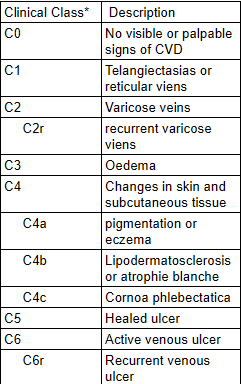
Chronic Venous Insufficiency is classified based on the CEAP scoring system, which is widely used by professionals to guide diagnosis and treatment. CEAP stands for Clinical, Etiological, Anatomical, and Pathophysiological. Each part of the score offers a structured approach to describe the severity and cause of venous disease.
CEAP Breakdown: C (Clinical) points to visible signs from C0 (no evidence of disease) to C6 (active ulceration); E (Etiological) identifies the cause (congenital, primary, secondary); A (Anatomical) describes the affected veins (superficial, deep, perforator); P (Pathophysiological) explains blood flow disturbances—either reflux or obstruction. This system helps inform optimal, individualized care.